Where Are the Kidneys?
A Complete Guide to Kidney Anatomy and Function
Have you ever stopped to wonder where your kidneys are located or what role they play in your overall health?
Maybe you’ve felt a dull ache in your lower back and wondered if it could be linked to your kidneys.
Understanding the location, size, and function of these vital organs is essential for maintaining good renal health.
Read on to learn everything you need to know about your kidneys.
The Location of Your Kidneys
Your kidneys are small but important organs located near the middle of your lower back, on either side of your spine.
They sit just below your rib cage, behind your abdominal organs. Contrary to popular belief, kidneys are positioned higher up than most people imagine – and to the side.
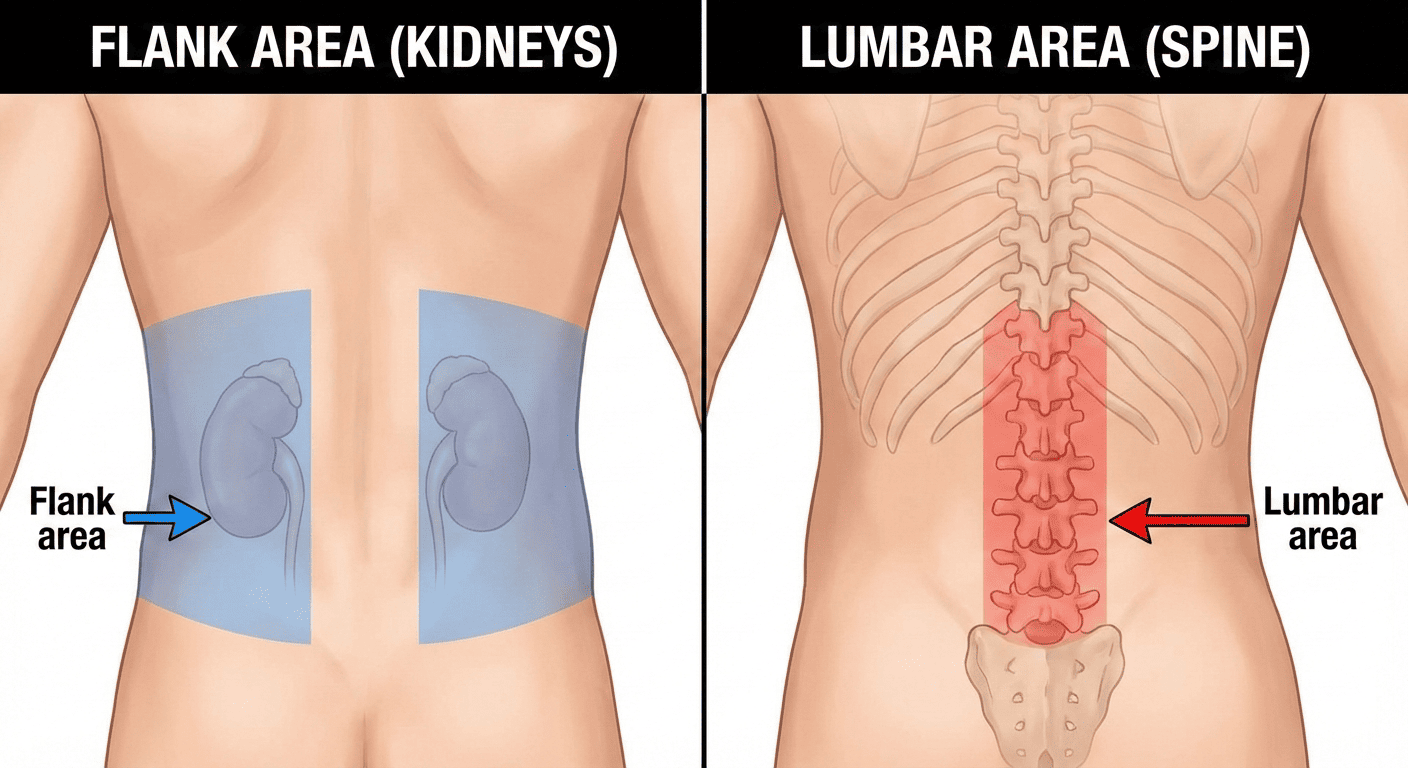
Note: the lumbar spinal area is lower and more central. This is partly why low back pain is raely due to kidney disease (see below).
Each kidney is well-protected by a combination of back muscles, lower ribs, and a layer of fat, which shields them from injury. This anatomical placement helps keep them safe while still allowing them to efficiently filter blood and produce urine.
Kidney Size and Shape
A typical human kidney is about the size of a fist or a palm, measuring approximately 12 cm long, 6 cm wide, and 3 cm deep.
Each kidney weighs around 150 grams, roughly the weight of a small apple. Interestingly, the right kidney is slightly smaller and lower than the left, due to the position of the liver pushing it down slightly.
Are Both Kidneys the Same Size?
Not exactly. The left kidney is usually slightly larger than the right. On average, the left kidney measures 11.2 cm in length, while the right kidney measures around 10.9 cm.
Despite this small difference, both kidneys perform the same vital functions, including filtering waste, balancing electrolytes, and maintaining fluid balance.
How Many Kidneys Do Humans Have?
Most people are born with two kidneys. But 1 in 1000 people have only one kidney due to congenital factors or surgical removal.
Surprisingly, a single kidney can often compensate for the missing one, growing slightly larger and providing up to 75% of normal kidney function. People with one kidney can lead completely healthy lives with proper monitoring and care.
Kidney Pain and Back Pain: What’s the Difference?
It’s common to confuse kidney pain with general back pain, but the two are often different. Kidney pain is usually felt higher up in the back, just under the ribs, and may radiate to the sides or abdomen.
Low and central back pain is typically caused by spinal issues, muscle strain, or joint problems rather than kidney problems.
Summary
In summary, your kidneys are located on either side of your spine, just below the rib cage, with the left kidney slightly larger and higher than the right. They are roughly the size of your palm and are well-protected by muscles, ribs, and fat.
Whilst most people have two kidneys, living with one is entirely possible, and kidney pain is usually distinguishable from common back pain.
Understanding kidney anatomy and function is crucial for maintaining optimal renal health and overall well-being.


